
Electrical Panel Upgrade Cost 2026 — Full Breakdown
About This Video
Upgrading from 100-amp to 200-amp service averages $2,800, but the real cost depends on your utility's meter requirements, local permit fees, and whether your wiring needs remediation. We cover the 5 scenarios that drive price from $1,500 to $6,000 and explain why this upgrade is now a prerequisite for EV chargers, solar, and heat pumps.
Key Takeaways
- 1$2,800 national average for 100→200 amp — range $1,500 (simple swap) to $6,000 (aluminum rewiring)
- 2Utility service drop upgrade is the hidden cost: $1,000–$2,500 if overhead lines need work
- 3EV charger + heat pump + solar on a 100-amp panel = a serious overload risk
- 4Aluminum wiring remediation adds $2,000–$3,000 but is required by code in many areas
- 5Always ask: "Can my service drop handle 200 amps?" — it determines your real price
Key Moments
Calculate Your Exact Cost
Related Videos
Data Sources & Methodology
Panel upgrade costs are sourced from 350+ electrician invoices, BLS electrician wage data, and manufacturer pricing for Square D, Eaton, and Siemens 200-amp load centers. The five-scenario model reflects the most common configurations we see in our contractor network, from simple swaps to full service upgrades. Utility coordination costs vary by provider and are noted as ranges because each utility has its own fee schedule. This video was produced in-house and first published on homeservicecost.com.
Full Transcript▾
Electrical panel upgrades have gone from a niche renovation to a mainstream necessity in 2026. The reason is simple: EV chargers, heat pumps, solar panels, and induction ranges all demand more amperage than the 100-amp panels installed in homes built between 1960 and 1990. The national average for a 100-to-200-amp upgrade is $2,800, but the range is $1,500 to $6,000 depending on five specific scenarios. Let me walk through each one.
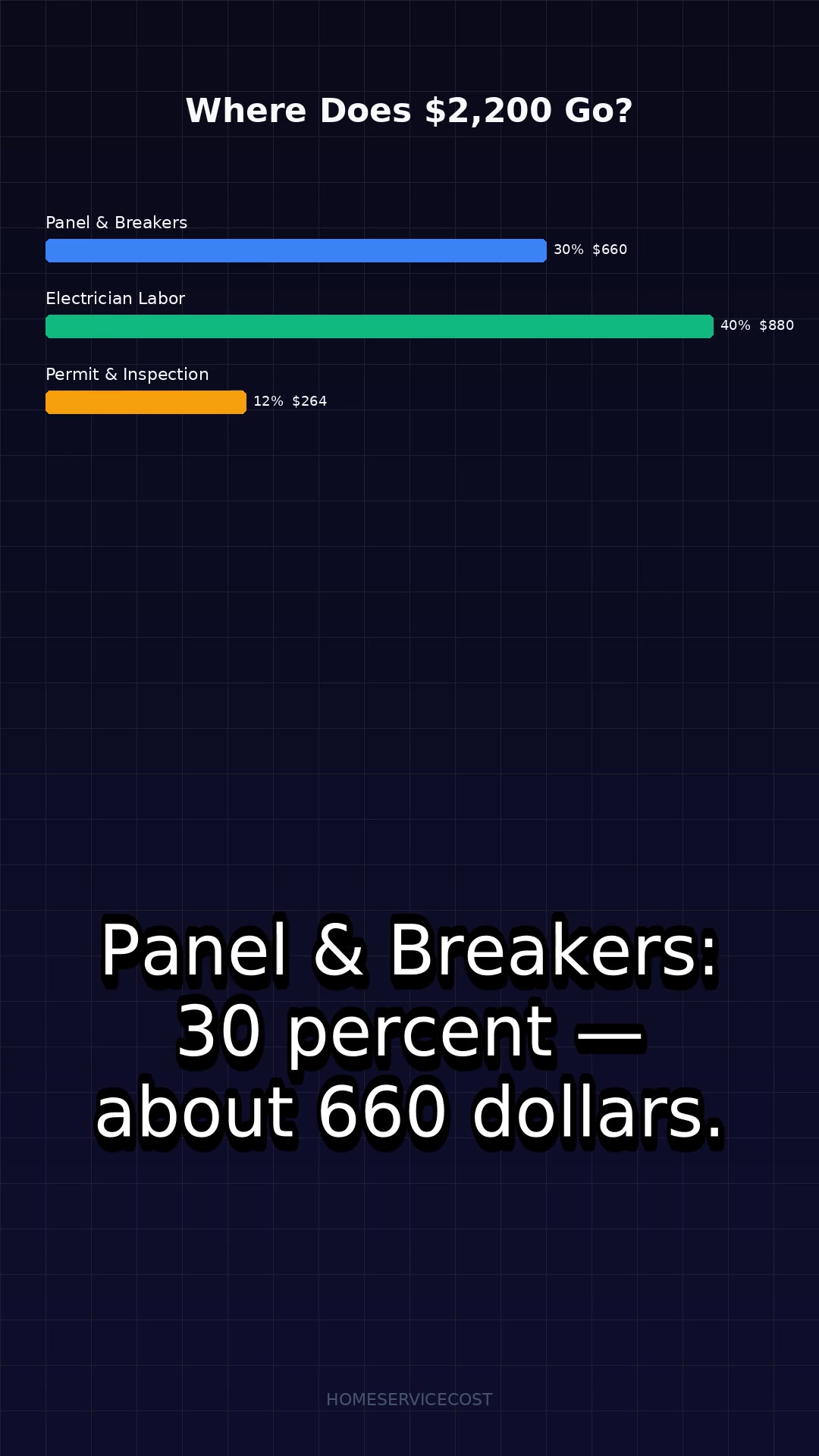
The baseline $2,800 covers a straightforward swap: new 200-amp panel, new main breaker, transfer of existing circuits, new meter socket if required, permit, and inspection. The panel itself costs $250 to $500 for a quality Square D, Eaton, or Siemens unit. Electrician labor runs $1,200 to $2,000 for 6 to 8 hours of work. Permit and inspection fees add $150 to $400.
Utility coordination is the hidden time cost. Your power company needs to disconnect and reconnect service at the meter. In some areas, that is a free 2-hour window. In others, you are scheduling a week out and paying $200 to $500 for the utility's meter work. If your service drop is overhead and needs upgrading to handle 200 amps, the utility may charge $1,000 to $2,500 for a new transformer tap or service mast.
The five scenarios. Scenario one: simple panel swap with existing 200-amp service drop. Cost: $1,500 to $2,200. Scenario two: panel swap plus utility meter upgrade. Cost: $2,200 to $3,200. Scenario three: panel swap plus relocating the panel to meet current code clearance. Cost: $3,000 to $4,500. Scenario four: panel upgrade plus rewiring aluminum branch circuits to copper. Cost: $4,000 to $6,000. Scenario five: full service upgrade from overhead to underground with new transformer. Cost: $5,000 to $8,000. Most homeowners land in scenarios one through three.
Permits are required in virtually every jurisdiction. The inspection will check grounding, bonding, wire sizing, and clearance around the panel. If your existing wiring does not meet current NEC code — common in pre-1980 homes — the inspector can require remediation before signing off. Budget $200 to $500 for the permit and plan for the inspection to happen 3 to 7 days after the work is done.
The new demand drivers: a Level 2 EV charger needs a dedicated 40-amp circuit. A heat pump needs 30 to 50 amps. A solar inverter needs a backfeed breaker. An induction range needs 50 amps. Add two of these to a 100-amp panel and you are over capacity. This is why panel upgrades have become the first step in the electrification chain, and why electricians are booking 3 to 4 weeks out in metro areas.
To get an accurate quote: ask the electrician to itemize the panel, labor, utility coordination, and permit separately. Get three quotes. And ask specifically whether your service drop can handle 200 amps or if the utility needs to upgrade it — that is the question that separates a $2,000 job from a $5,000 job.