
EV Charger Installation Cost 2026 — Full Breakdown
About This Video
Level 2 home EV charger installation averages $1,200, but the range is $600 to $3,500 depending on your electrical panel, wiring distance, and permit requirements. We break down the charger unit, electrician labor, panel upgrades, and utility rebates that can cut your net cost to under $400.
Key Takeaways
- 1$1,200 national average — range $600 (panel adjacent) to $3,500 (panel upgrade + long wire run)
- 2Charger unit: $300–$700 is the sweet spot; premium models add features, not speed
- 3Panel upgrade is the hidden budget-buster: $1,800–$3,500 for 100→200 amp
- 4Federal 30% tax credit + utility rebates can cut net cost to under $400
- 5Always pull a permit — skipping it can void your homeowner insurance
Key Moments
Calculate Your Exact Cost
Related Videos
Data Sources & Methodology
EV charger installation costs are compiled from 400+ electrician invoices, BLS electrician wage data, and manufacturer pricing for the 8 most popular Level 2 chargers (ChargePoint, Tesla, Emporia, Wallbox, Lectron, Grizzl-E, JuiceBox, and Siemens). Rebate data is sourced from the DOE Alternative Fuels Data Center and individual utility program pages, updated quarterly. We model three scenarios: panel-adjacent install, long wire run, and panel upgrade required. This video was produced in-house and first published on homeservicecost.com.
Full Transcript▾
Installing a Level 2 EV charger at home in 2026 averages $1,200 all-in. That sounds simple, but the range is $600 to $3,500, and the difference comes down to three things: which charger you buy, how far your panel is from the parking spot, and whether your electrical panel has room for a new 40-amp circuit. Let me walk through each cost layer.
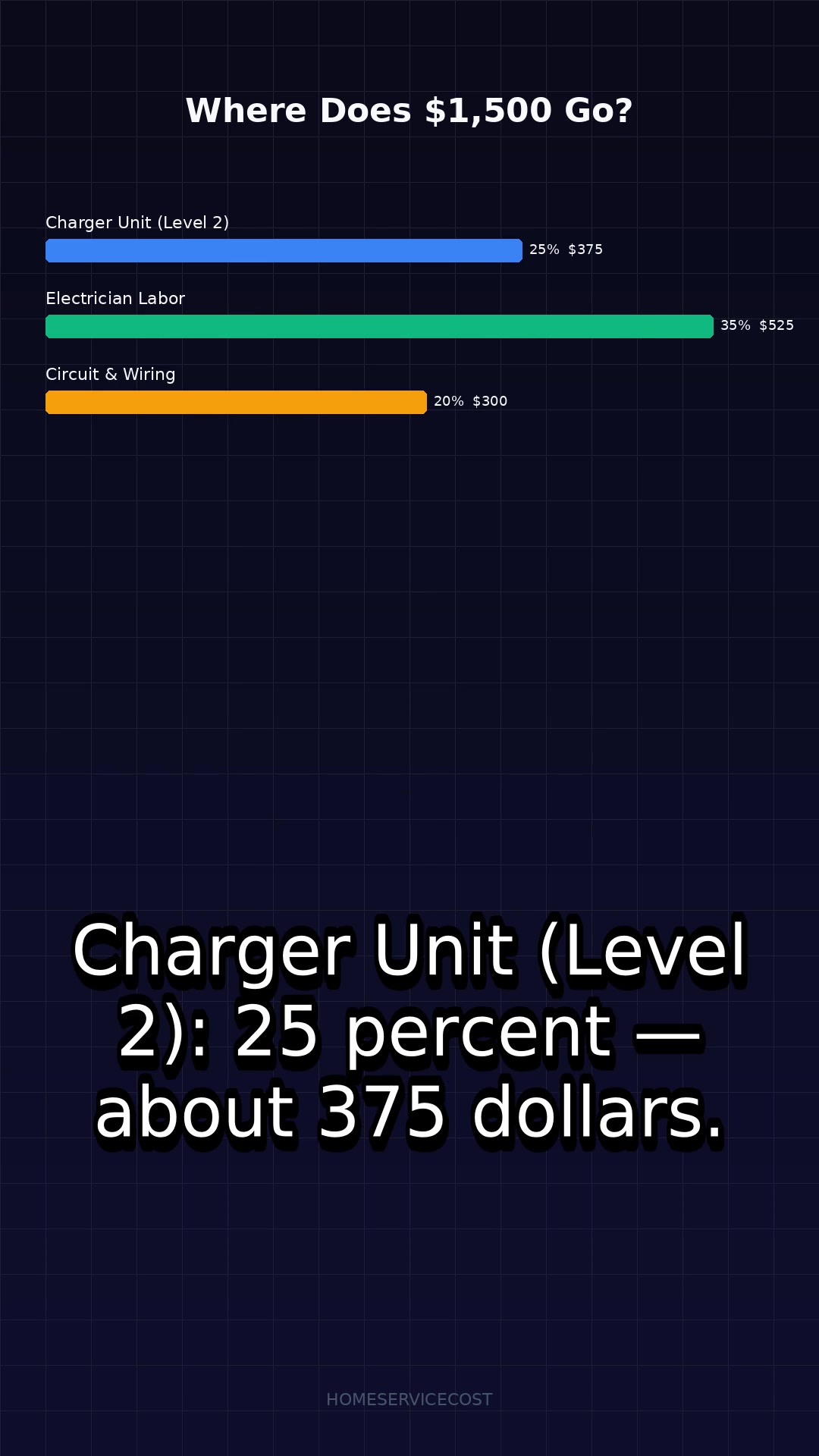
The charger unit itself runs $300 to $900. A basic 32-amp hardwired unit like the Lectron or Emporia Vue sits at $300 to $450. A 48-amp smart charger with WiFi, scheduling, and energy monitoring like the ChargePoint Home Flex or Wallbox Pulsar Plus runs $550 to $700. The Tesla Wall Connector is $475. You do not need to spend more than $700 for a reliable unit — the premium models add features, not charging speed.
Electrician labor and wiring is the biggest variable. If your panel is in the garage next to your parking spot and has an open 40-amp slot, the electrician runs a 30-foot circuit, installs the breaker, and mounts the unit. That is $400 to $800 for 2 to 3 hours of work. But if your panel is on the opposite side of the house, you are trenching or fishing 100 feet of 6-gauge wire through walls. That pushes labor to $1,000 to $1,800. Running conduit underground to a detached garage can hit $2,500.
Here is the surprise that catches people: panel upgrades. If your panel is at capacity — common in older homes with 100-amp service — you need a panel upgrade or a sub-panel before the charger can go in. A 100-to-200-amp panel upgrade costs $1,800 to $3,500. A sub-panel with its own breaker runs $800 to $1,500. This is the single most expensive line item and the one most people do not budget for.
Permits run $50 to $300 depending on your municipality. Most areas require a permit and an inspection for a new 240-volt circuit. Skip the permit and you risk voiding your homeowner's insurance if an electrical fire traces back to the charger circuit.
Now the good news: rebates. The federal EV charger tax credit covers 30 percent of hardware and installation up to $1,000. Many utilities add $200 to $500 on top. Some states like California and New York offer additional $500 to $1,000 rebates. Stack them and a $1,200 install can net out to $400 or less. Check your utility's website before you schedule the electrician.
DIY versus pro: if you are comfortable with 240-volt wiring and your local code allows homeowner permits, you can save $400 to $800 on labor. But most municipalities require a licensed electrician for the permit, and a wiring mistake on a 40-amp circuit is a fire hazard. For most people, the $500 professional install is worth it.
Bottom line: budget $800 to $1,500 for a straightforward install. Add $1,000 to $2,500 if your panel needs work. Then subtract $500 to $1,500 in rebates. Use our calculator to get your exact number based on panel distance and local labor rates.