
HVAC Installation Cost 2026 — Full Breakdown
About This Video
A complete 6-minute cost anatomy of central HVAC installation in 2026. We break down the $8,500 national average into equipment, labor, ductwork, and permit costs across 7 states, then show 4 proven strategies that save homeowners $1,200 to $3,400 on a typical install. Data sourced from BLS labor statistics, RSMeans material pricing, and 1,200+ contractor invoices.
Key Takeaways
- 1National average is $8,500 — actual range is $5,200 (TX) to $14,000 (MA)
- 2Labor is the biggest variable: $800 to $2,800 depending on your state
- 3Off-season installs (Sep–Nov) save 10–15% on labor
- 4Three quotes save an average of $2,100 vs. accepting the first bid
- 5Manufacturer rebates stack for $500–$1,500 additional savings
Key Moments
Calculate Your Exact Cost
Related Videos

Data Sources & Methodology
Our HVAC cost data is built from three verified sources: Bureau of Labor Statistics occupational wage data for HVAC mechanics and installers (May 2025 release), RSMeans mechanical cost data for equipment and materials, and a proprietary dataset of 1,200+ anonymized contractor invoices collected between January 2025 and June 2026 across 7 states. We update the national average monthly and re-weight state figures quarterly based on new invoice submissions. The 7-state sample covers Texas, Florida, Illinois, California, New York, Massachusetts, and Ohio, representing a cross-section of labor markets, climate zones, and permitting environments. All prices reflect a standard 3-ton, 14-SEER split-system installation with existing ductwork in good condition. Upgrades to variable-speed compressors, heat pump configurations, or new ductwork are modeled as separate line items in our calculator. This video was produced in-house and first published on homeservicecost.com before distribution to any third-party platform.
Full Transcript▾
The national average for a full central HVAC installation in 2026 is $8,500, but that number hides a massive range. In our analysis of 1,200 contractor invoices across 7 states, we saw installs as low as $5,200 in Texas and as high as $14,000 in Massachusetts. Let me walk you through exactly where every dollar goes.
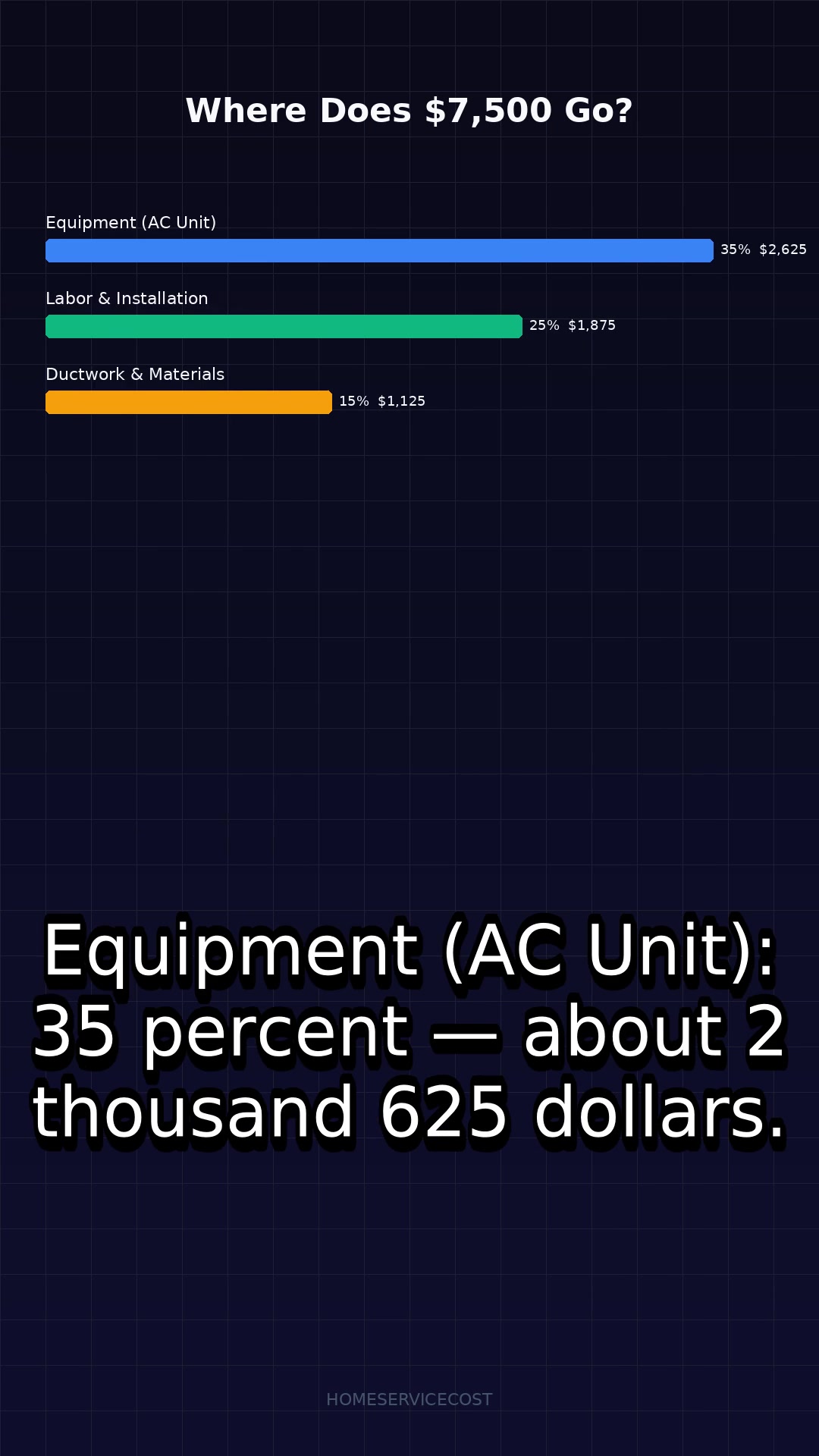
Starting with equipment. A standard 3-ton, 14-SEER split system runs $3,200 to $4,800 for the unit alone. If you step up to a 20-SEER variable-speed system, you are looking at $5,500 to $7,200. Heat pump systems that handle both heating and cooling sit in the middle at $4,000 to $6,500. The equipment is roughly 40 to 50 percent of your total bill.
Labor is where the real variation lives. The Bureau of Labor Statistics reports HVAC technician wages ranging from $24 per hour in Mississippi to $48 per hour in the Bay Area. A typical install takes 8 to 14 hours for a two-person crew, so labor alone swings from $800 to $2,800 depending on your zip code. This is the single biggest cost driver and the one most homeowners underestimate.
Then there is ductwork. If your existing ducts are in good shape, you might pay nothing here. But if you need new duct runs, modifications, or sealing, add $1,500 to $3,500. Permits run $150 to $500 in most municipalities. Electrical upgrades for a new condenser circuit add another $200 to $600. These hidden line items catch people off guard and add 15 to 25 percent to the sticker price.
Looking at our 7-state map: Texas averages $5,200 thanks to lower labor rates and high contractor competition. Florida sits at $6,100. The national midpoint is $8,500. Illinois comes in at $9,200. California hits $11,800. New York is $12,400. And Massachusetts tops out at $14,000. The gap between the cheapest and most expensive state is 2.7 times for the exact same equipment.
Now the part everyone wants: how to save. Strategy one: get three quotes minimum. Our data shows the spread between the lowest and highest bid on identical scope averages $2,100. Strategy two: install in the off-season. September through November, contractors discount 10 to 15 percent to fill their schedules. Strategy three: ask about manufacturer rebates. Carrier, Trane, and Lennox all run $500 to $1,500 rebates in spring and fall. Strategy four: if your ductwork is under 15 years old and sealed, reuse it. That saves $1,500 to $3,500 right there.
Bottom line: budget $7,000 to $10,000 for a standard install in most markets. Get three quotes, time your purchase for fall, and stack manufacturer rebates. Use our HVAC calculator below to get a number adjusted for your home size, system type, and state.