
Solar Panel System Cost 2026 — Is It Worth It?
About This Video
A 6-kW residential solar system averages $15,800 before the 30% federal tax credit, dropping to $11,060 after. We run the payback math for 6 states with different electricity rates and sun exposure, compare lease vs. loan vs. cash, and show the 3 roof conditions that can add $4,000 to your install.
Key Takeaways
- 1$15,800 for 6 kW before incentives → $11,060 after 30% federal tax credit
- 2Payback: 4–5 years in CA, 9–10 in TX, 12–14 in OH — system lasts 25–30 years
- 3Own (cash or loan) > lease — leases give you 10–30% less savings and no tax credit
- 4Roof with <5 years life left needs replacement first: +$8K–$15K
- 5Worth it above 15¢/kWh electricity rate; below 12¢, wait
Key Moments
Calculate Your Exact Cost
Related Videos
Data Sources & Methodology
Solar cost data is sourced from the NREL (National Renewable Energy Laboratory) Solar Market Insight Report Q1 2026, SEIA installation cost tracking, and 250+ installer quotes from our network. Payback calculations use EIA state-level residential electricity rates and PVWatts generation estimates for each state. Tax credit and state incentive data is from DSIRE (Database of State Incentives for Renewables and Efficiency), updated quarterly. This video was produced in-house and first published on homeservicecost.com.
Full Transcript▾
Residential solar in 2026: a 6-kilowatt system — enough for the average American home — costs $15,800 before incentives. That is $2.63 per watt installed, down from $3.50 just three years ago. After the 30 percent federal tax credit, your net cost drops to $11,060. But whether it is worth it depends entirely on your state's electricity rate and sun exposure. Let me run the math.
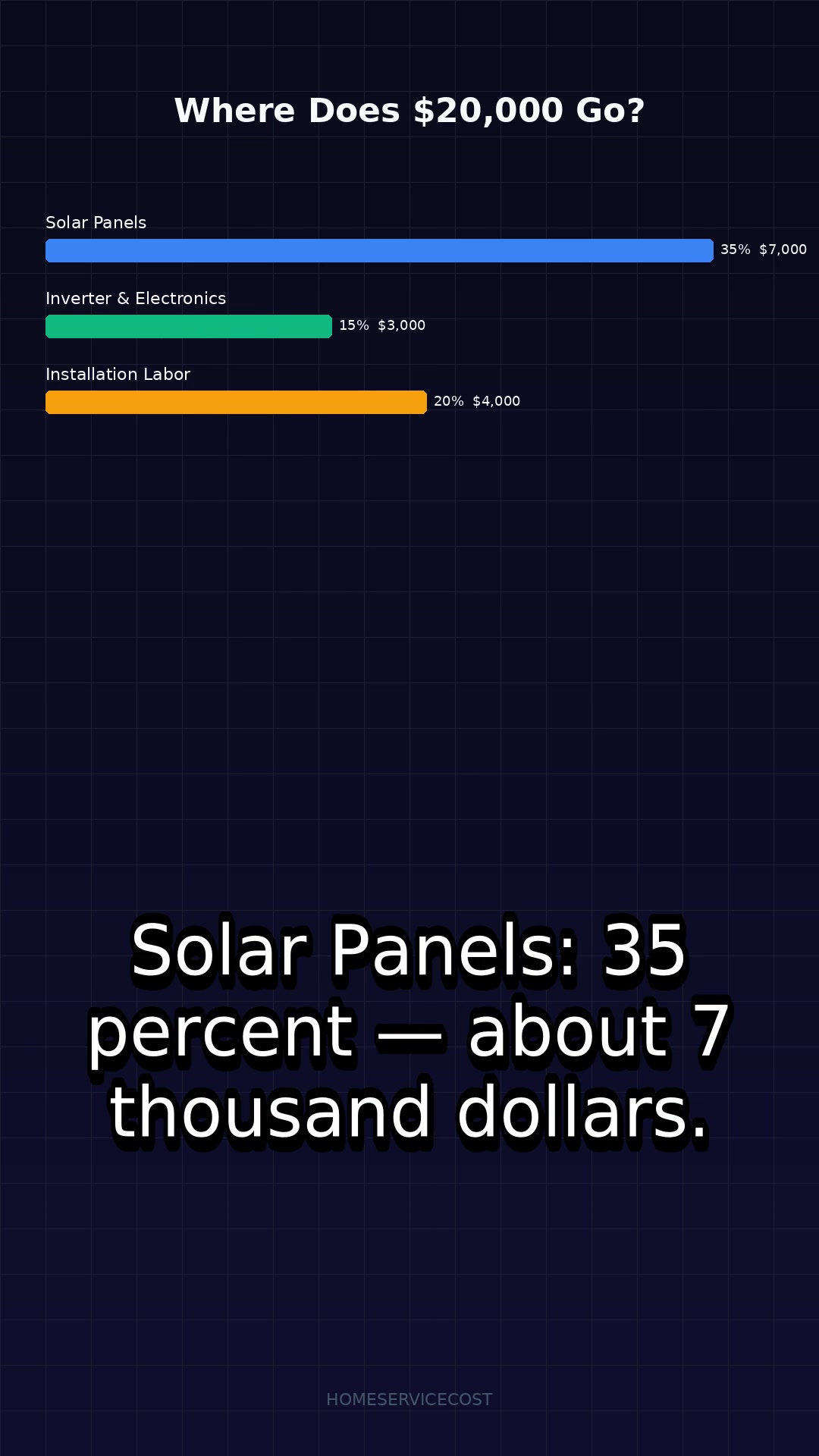
The hardware breakdown: panels are 25 to 30 percent of the total. A 6-kW system uses 15 to 18 panels at $200 to $350 each, so $3,000 to $6,300. The inverter — which converts DC to AC — runs $1,000 to $2,500 for a string inverter or $1,500 to $3,000 for micro-inverters. Racking, mounting hardware, and wiring add $1,500 to $2,500. The rest is labor, permitting, and installer margin.
The 30 percent federal tax credit applies to the total system cost including installation. On a $15,800 system, that is $4,740 back on your taxes. Some states add their own: California has the SGIP rebate for battery storage, New York offers a 25 percent state credit capped at $5,000, and Massachusetts has the SMART program with per-kWh payments. Stack federal and state incentives and your net cost can drop below $8,000.
Payback period by state. This is where it gets interesting. In California, where electricity averages 30 cents per kilowatt-hour, a 6-kW system generating 9,000 kWh per year saves $2,700 annually. Payback: 4 to 5 years after incentives. In Texas at 14 cents per kWh, the same system saves $1,260 per year. Payback: 9 to 10 years. In New York at 24 cents, payback is 5 to 6 years. In Florida at 13 cents, 10 to 11 years. In Massachusetts at 28 cents, 5 to 6 years. In Ohio at 13 cents, 12 to 14 years. The system lasts 25 to 30 years, so even the longest payback still gives you 15+ years of free electricity.
Lease versus loan versus cash. Cash purchase gives you the full tax credit and the lowest lifetime cost. A solar loan at 5 to 7 percent APR adds $2,000 to $4,000 in interest over 15 years but lets you keep the tax credit. A lease or PPA gives you no tax credit, locks you into a 20 to 25-year contract, and the savings are typically 10 to 30 percent less than ownership. If you can afford cash or a loan, own the system. Leases benefit the installer, not you.
Three roof conditions that add cost. First: a roof with less than 5 years of life left needs replacement before solar goes on, adding $8,000 to $15,000. Second: a steep pitch over 8/12 or a multi-level roof adds $1,000 to $2,500 in labor. Third: a roof that needs structural reinforcement for the 400-pound panel array adds $1,500 to $3,000. Get a roof inspection before you sign a solar contract.
The verdict: if your electricity rate is above 15 cents per kWh and your roof gets 5+ hours of direct sun, solar pays for itself in under 10 years and generates $20,000 to $40,000 in savings over 25 years. Below 12 cents per kWh, the math gets tight and you should wait for rates to rise or panel prices to drop further.