
Window Replacement Cost 2026 — Full Breakdown
About This Video
Replacing 10 windows averages $6,200, but per-window pricing swings from $350 for a vinyl double-hung to $1,800 for a wood-clad casement. We compare vinyl, fiberglass, and wood frames across cost, energy savings, and lifespan, explain the full-frame vs. pocket-install decision, and show how the ENERGY STAR tax credit changes the math.
Key Takeaways
- 1$620/window average — vinyl $350–$650, fiberglass $550–$950, wood-clad $800–$1,800
- 2Pocket install saves 50% on labor vs. full-frame, but only works if existing frame is sound
- 3Low-E + argon adds $50–$130/window and is worth it in every climate
- 4ENERGY STAR tax credit: 30% up to $600/year — plus utility rebates
- 5Resale recoup: 60–70% of cost. Energy payback: ~20 years, but comfort is immediate
Key Moments
Calculate Your Exact Cost
Related Videos
Data Sources & Methodology
Window replacement costs are compiled from 400+ contractor invoices, the Efficient Windows Collaborative pricing data, and manufacturer catalogs for Andersen, Pella, Marvin, JELD-WEN, and Simonton product lines. Energy savings projections use DOE ENERGY STAR savings estimates segmented by climate zone. Resale recoup data references Remodeling Magazine's 2026 Cost vs. Value Report. This video was produced in-house and first published on homeservicecost.com.
Full Transcript▾
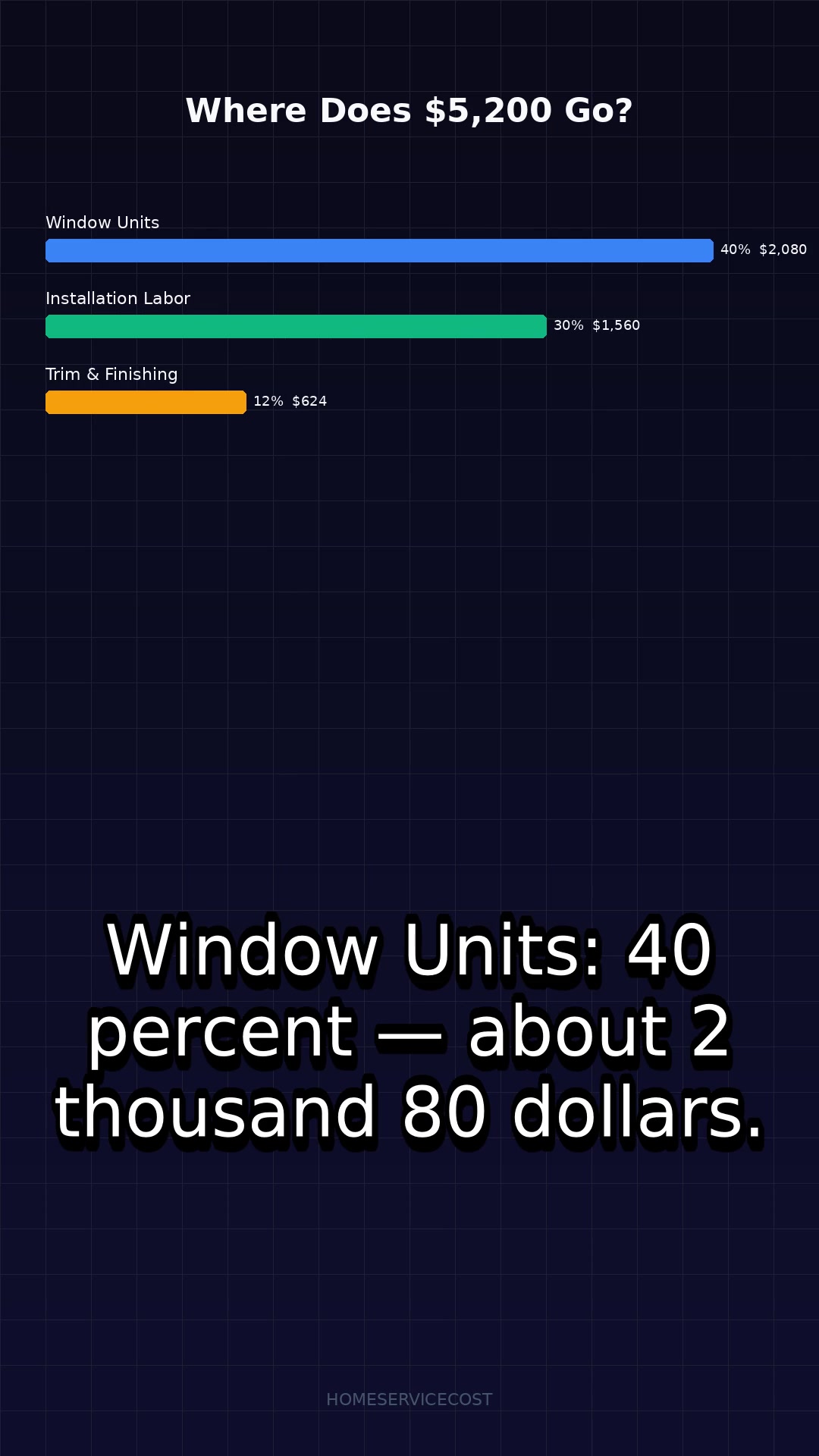
Window replacement in 2026 averages $620 per window installed, so a typical 10-window home runs $6,200. But per-window pricing ranges from $350 for a basic vinyl double-hung to $1,800 for a wood-clad casement with triple-pane glass. The three decisions that drive cost are frame material, installation method, and glass package. Let me walk through each.
Frame material is the biggest cost driver. Vinyl is the volume leader at $350 to $650 per window installed. It is low-maintenance, decent insulation, and lasts 20 to 30 years. The downside: it cannot be painted, expands and contracts with temperature, and the welds can fail on cheap brands. Fiberglass is the upgrade at $550 to $950 per window. It is stronger than vinyl, can be painted, has better thermal performance, and lasts 30 to 50 years. Wood-clad is the premium at $800 to $1,800 per window. The interior is real wood — beautiful, paintable, stainable — and the exterior is aluminum or vinyl for weather resistance. Wood-clad lasts 30+ years with proper maintenance but requires repainting every 8 to 12 years.
Installation method matters as much as the window itself. A pocket install — also called insert replacement — slides the new window into the existing frame. It is faster, cheaper at $150 to $250 per window for labor, and preserves the interior and exterior trim. But it only works if the existing frame is square, level, and rot-free. A full-frame install removes the entire window down to the rough opening, replaces the frame, sill, and trim, and costs $300 to $500 per window for labor. It is required when there is rot, water damage, or you want to change the window size. Full-frame costs 50 to 100 percent more in labor but gives you a like-new installation.
Glass options: double-pane is standard and included in the base price. Low-E coating — which reflects heat in summer and retains it in winter — adds $30 to $80 per window and is worth it in every climate. Argon gas fill between the panes adds $20 to $50 and improves insulation by 10 percent. Triple-pane adds $100 to $200 per window and makes sense in extreme cold climates like Minnesota or Maine, but the energy savings rarely justify the cost in moderate zones.
The ENERGY STAR tax credit: windows that meet ENERGY STAR Most Efficient criteria qualify for a 30 percent tax credit up to $600 per year. On a $6,200 project, that is $600 back. Some utilities and states add rebates of $50 to $200 per window. Check the ENERGY STAR website for the current qualifying U-factor and SHGC ratings for your climate zone.
Energy savings ROI: the Department of Energy estimates that replacing single-pane windows with ENERGY STAR double-pane saves $125 to $450 per year on heating and cooling for a typical home. At $300 per year average savings, the $6,200 investment pays back in about 20 years through energy alone. But the real value is comfort — eliminating drafts, reducing noise, and preventing UV fading of furniture and floors. At resale, window replacement recoups 60 to 70 percent of cost according to Remodeling Magazine.
Comparing quotes: get three, and make sure each specifies the same frame material, glass package, and installation method. Ask for the U-factor and SHGC ratings in writing. And check whether the quote includes interior trim repair and exterior caulking — these are commonly excluded and add $50 to $100 per window if billed separately.